
Most business leaders can describe their ERP clearly on paper. They know which modules are licensed, which departments log in, which reports circulate on Mondays. What far fewer can describe honestly is how work actually flows around that ERP. Between the system of record and the system people actually use to get things done, there is usually a gap. The gap is where the real business lives.
This piece is not a diagnostic. It does not ask you to score yourself. It asks you to pay attention, for one working week, to seven specific moments. If you notice more than three of them, the ERP you describe on paper is not the one running your business.
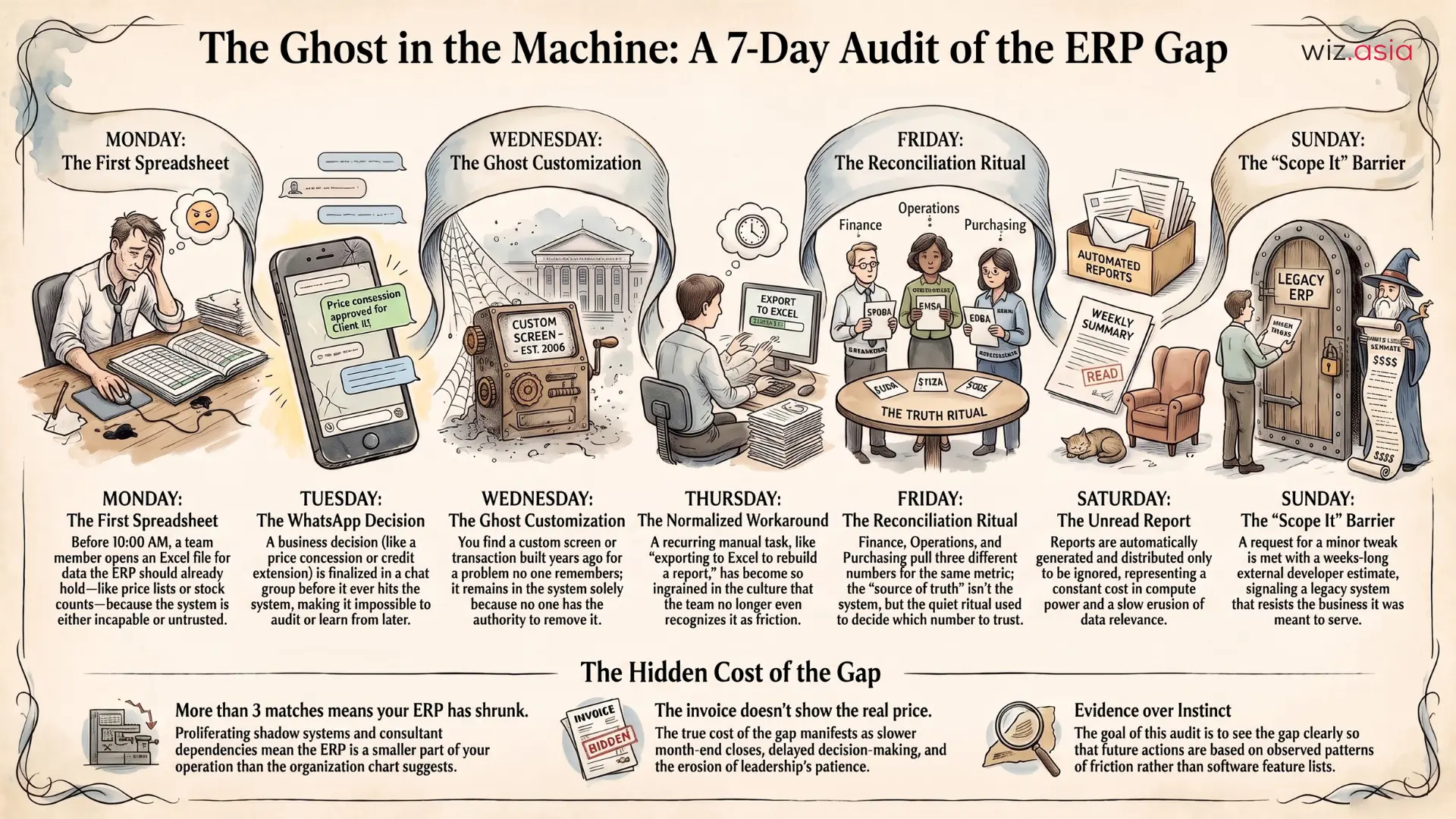
Here is what to watch for.
Monday — the first spreadsheet. Sometime before ten in the morning, someone on your team will open an Excel file containing information your ERP should already hold. A price list, a customer status tracker, a stock count. Notice which file it is, and why it exists. Spreadsheets do not appear randomly. Each one exists because the ERP could not — or because it could but nobody trusted the answer.
Tuesday — the WhatsApp decision. A business decision will be made today in a chat group before it is recorded anywhere in a system. A price concession. A credit extension. An expedited delivery. By the time it reaches the ERP, it is already done. The system is documenting what happened; it is not where the decision was made. Decisions made outside a system of record are decisions that cannot be audited, contested, or learned from later.
Wednesday — the custom transaction nobody remembers requesting. Somewhere in your ERP is a transaction or screen that was built years ago to solve a specific problem. The business reason is gone. The person who requested it has left. The consultant who wrote it has moved on. But it remains — maintained, tested during every upgrade, quietly billed for in every support contract. Notice which custom pieces of your system are still in active use and which exist only because nobody has had the authority to remove them. Each one is a cost you pay to carry history.
Thursday — the workaround. Notice a workaround that has become so normal your team no longer calls it a workaround. A recurring task that still begins with "first, export from the ERP to Excel." A report that exists only because someone rebuilds it manually each month. A customer status tracked in a private folder because the system does not have a field for it. Normalised workarounds are the most expensive form of friction because nobody complains about them anymore.
Friday — the reconciliation that crosses three modules. As month-end closes, notice which reconciliation requires pulling data from three separate parts of the system to get one answer. Finance pulls a number. Operations pulls a different one. Purchasing pulls a third. The three should match and they do not, and the team has built a quiet ritual for deciding which one to trust. When the system of record requires cross-module reconciliation to produce a trustworthy number, the system is no longer the source of truth — the ritual is.
Saturday — the unread report. Over the weekend, or first thing Monday, notice which reports get generated, distributed, and ignored. Reports that exist because somebody once asked for them and no one has had the authority to switch them off. Reports that get opened, glanced at, closed. Every unread report is cost without return — compute, attention, and the slow erosion of whether any report matters.
Sunday — the consultant who bills by the hour to change a field. Think about the last time your team asked for a small change to the ERP — a new field on a form, an additional status on a record, a minor tweak to a report. How long did it take, and how much did it cost? Modern business systems treat configuration as something the business itself does, in hours. Legacy systems treat it as developer work, billed externally, scheduled in weeks. If your team has learned to stop asking because the answer is always "we will need to scope it," you are already paying for a system that resists the business it was meant to serve.
What noticing more than three of these actually means.
The ERP you chose was meant to be your system of record, your operational backbone, your single source of truth. When shadow systems, legacy customisations, cross-module reconciliations, and consultant dependencies proliferate around it, the ERP has quietly become a smaller part of your operation than it appears on an organisation chart.
The cost of this rarely shows up on any invoice. It shows up in slower month-end closes, in decisions that take longer because the data is not trusted, in support bills that creep year over year, in the senior team's patience with systems that should have repaid their investment by now.
None of this means your ERP is the wrong system. It might mean it is configured for a business you used to be, not the one you have now. It might mean customisations made years ago are now load-bearing in ways nobody documented. It might mean the system is fine and the processes around it have drifted. The point of the exercise is not to diagnose the cause. The point is to see the gap clearly, so that when the time comes to act on it, you act with evidence rather than instinct.
What these seven moments look like when the platform handles them natively
Each of the seven moments above exists because of a structural gap between what the business needs and what the platform provides. Some of those gaps are configuration problems. Some are architecture problems. The distinction matters, because a configuration problem can be fixed inside any system. An architecture problem follows you from one version to the next.
Here is what changes when the platform is designed to close those gaps by default.
Monday's spreadsheet disappears — not because someone banned it, but because the system gave a trustworthy answer. Odoo's reporting runs against live data across every module. A price list, a stock count, a customer status — these are not reports to be pulled. They are views into data that is already there, updated as the work happens. When the system is trusted, the spreadsheet has no job to do.
Tuesday's WhatsApp decision moves into the system. Odoo's approval workflows can be configured to match how decisions actually happen — including mobile approvals, multi-level sign-offs, and exception handling. A price concession or credit extension gets decided, approved, and recorded in the same flow. The audit trail builds itself because the decision happened inside the system, not alongside it.
Wednesday's custom transaction gets questioned. Odoo's modular architecture means fewer custom transactions are needed in the first place. Standard modules cover most operational workflows natively. When customisation is genuinely needed, it is built on an open framework that does not carry the same upgrade burden as legacy bolt-on development. The cost of carrying history drops because the system does not penalise you for evolving.
Thursday's workaround loses its reason to exist. The workaround that starts with "first, export to Excel" exists because the system cannot do what the business needs in one step. Odoo's interface is consistent across modules — the same logic drives purchase orders, sales pipelines, inventory dashboards, and HR workflows. When the system can do it in one step, the export disappears. When it needs a new field, the business adds it — in hours, not weeks, without a consultant.
Friday's reconciliation becomes unnecessary. The cross-module reconciliation ritual exists because different parts of the system hold different versions of the same number. Odoo stores data once and surfaces it across every module that needs it. Finance, operations, and purchasing see the same figure because it is the same record. There is nothing to reconcile when there was never a divergence.
Saturday's unread report gets replaced by a dashboard the team actually uses. Odoo's reporting is configurable by the business — not by a developer. Reports that no one reads get switched off by the people who used to ignore them. Dashboards get built around the questions the team actually asks, updated in real time, and visible to anyone with the right access. The signal-to-noise ratio improves because the business controls what gets measured.
Sunday's consultant call does not happen. Adding a field, changing a status, adjusting a report layout — these are configuration tasks in Odoo, not development projects. The business team does them. The cost is hours of internal time, not weeks of external billing. When your team stops asking because the system makes it easy to act, you have crossed from a system that resists the business to one that serves it.
None of this means every legacy ERP moment disappears on day one. Implementation is real work. Data migration is real work. Change management is real work. But the architecture underneath determines whether the seven moments return after go-live or whether the conditions that created them have been structurally removed.
If three or more of these observations match your week
The conversation worth having is not about software features. It is about which of these patterns is costing you most — and whether the cost is worth the inertia of leaving it in place.
The seven moments exercise gives you evidence. The sorting that follows — which observations are adaptations worth keeping, which are symptoms to eliminate, which are risks that need action now — gives you a framework. The platform underneath determines whether you can act on what you found.
Book a 30-minute conversation with the Wiz.Asia team. Bring the moments you noticed. We will help you sort them — which ones are configuration problems fixable in your current system, which ones are architectural problems that follow you from version to version, and what it would look like to address the ones that matter most on Odoo.
No deck. No demo. You bring what you observed. We bring pattern recognition from comparable organisations across Malaysia and Southeast Asia.
Book a 30-minute conversation →
Wiz.Asia is an authorised Odoo Silver Partner helping organisations evaluate and modernise their ERP platforms — starting with the patterns that cost the most and the workflows that matter first.