From Five-Person Handoffs to Autonomous Ordering
How a premium butcher turned WhatsApp into a self-driving sales channel
At a glance
Industry | Premium meat retail — Wagyu, Japanese A5, grass-fed cuts, ready-to-cook skewers and combo boxes |
Market | Peninsular (West) Malaysia, direct-to-consumer |
Primary channel | |
Solution | Conversational AI agent integrated directly with the company's ERP |
Languages | English and Malay, including natural code-switching ("rojak") / Manglish) |
The challenge: a chat channel running on manual labour
The business already sold through the channel its customer preferred — WhatsApp. The problem was everything that happened behind the message.
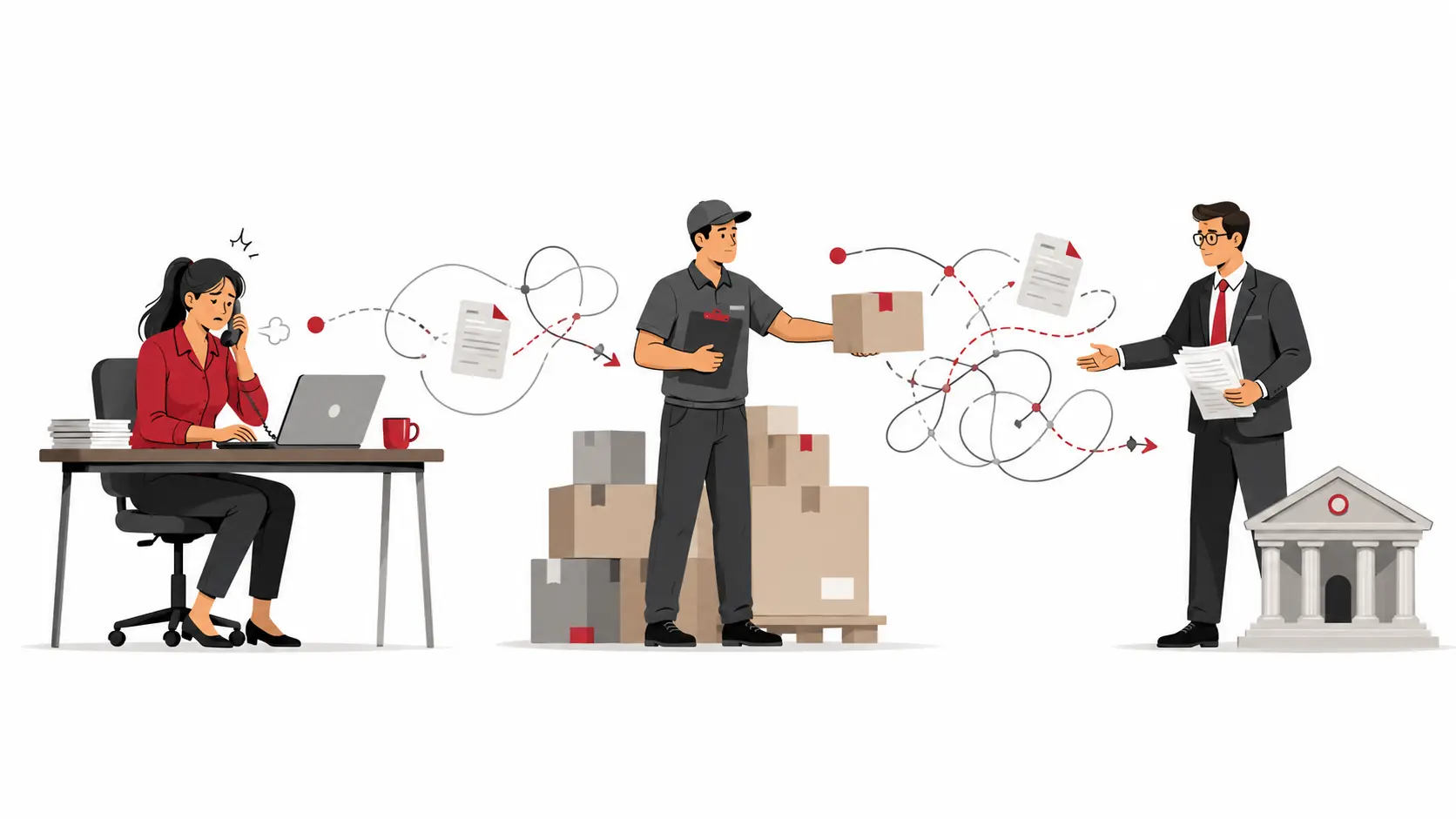
A single order moved through at least three teams before it was fulfilled.
- Customer Service received the WhatsApp enquiry, manually checked whether items were in stock, confirmed the order, and issued receipt.
- Inventory / Logistics was pinged separately to re-confirm stock and cut a delivery order (DO).
- Finance had the invoice and receipt passed to it by hand, then reconciled the payment against the bank before the order was cleared.
Every order was a relay race of human handoffs. That created the usual failure modes: slow replies during peak hours, stock that was "confirmed" by one person and gone by the time another checked, payment confirmation that lagged, and a headcount cost that scaled linearly with order volume. The channel could not grow without hiring.
The solution: WhatsApp order automation, wired into Odoo
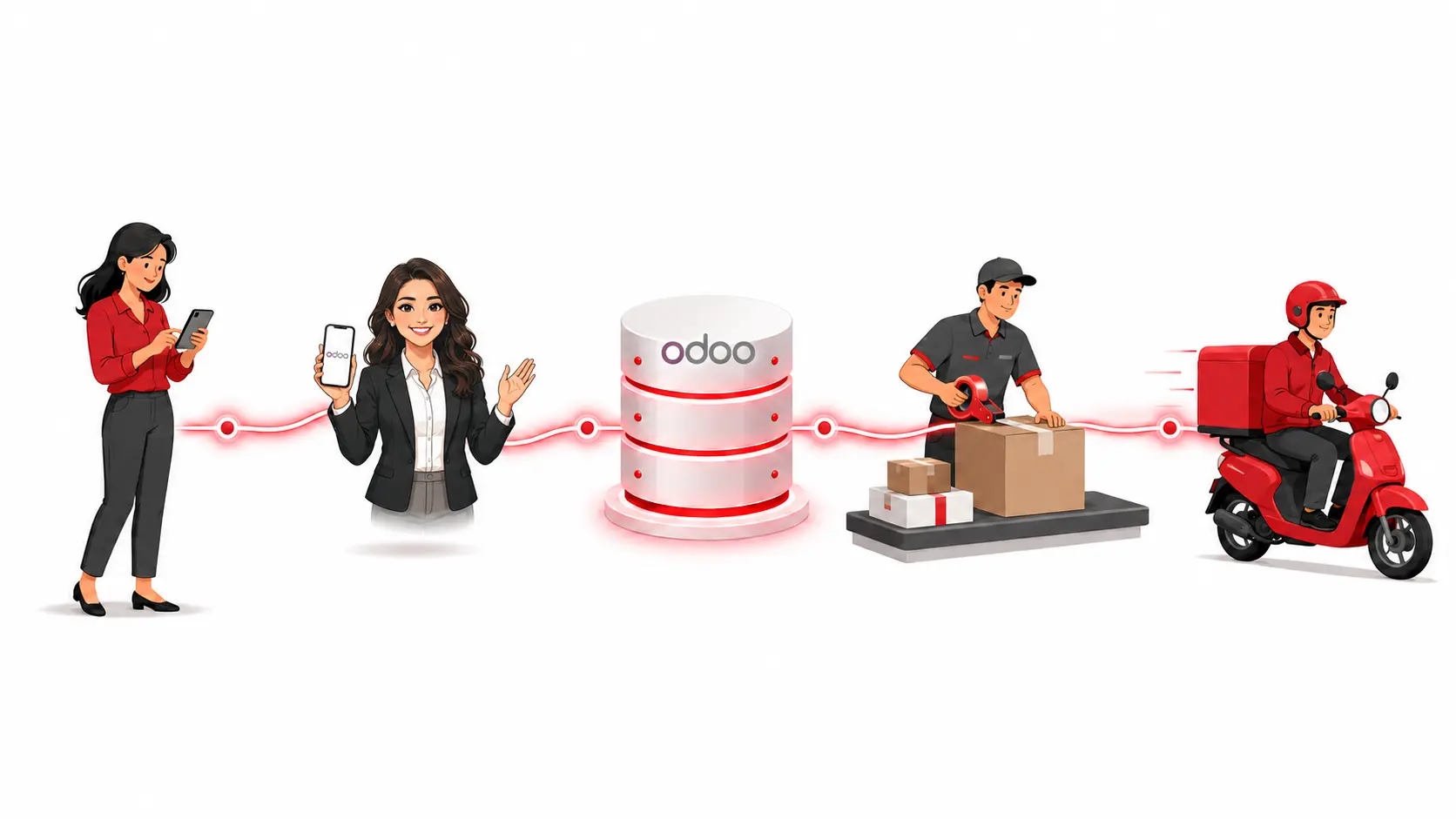
The company deployed a conversational AI agent on WhatsApp that talks to customers in natural language and reads and writes to the Odoo ERP in real time. Instead of a human sitting between the customer and the back office, the agent is the back office for the entire pre-fulfilment journey. This kind of Odoo WhatsApp integration — a live link between the chat and the ERP is what separates a real sales agent from a chatbot.
The agent handles, autonomously:
- Customer registration — captures name and contact details into the customer record in Odoo.
- Live inventory — answers "what's in stock?" against actual ERP stock levels, not a static price list.
- Promotions and bundles — surfaces current combo boxes and packages pulled from the Odoo catalogue.
- Payment — generates a payment link, processes the transaction, and posts the corresponding accounting entries.
- Fulfilment trigger — issues the delivery order so Logistics only has to pick, pack, and ship.
Inside the customer journey: a conversational AI agent on WhatsApp
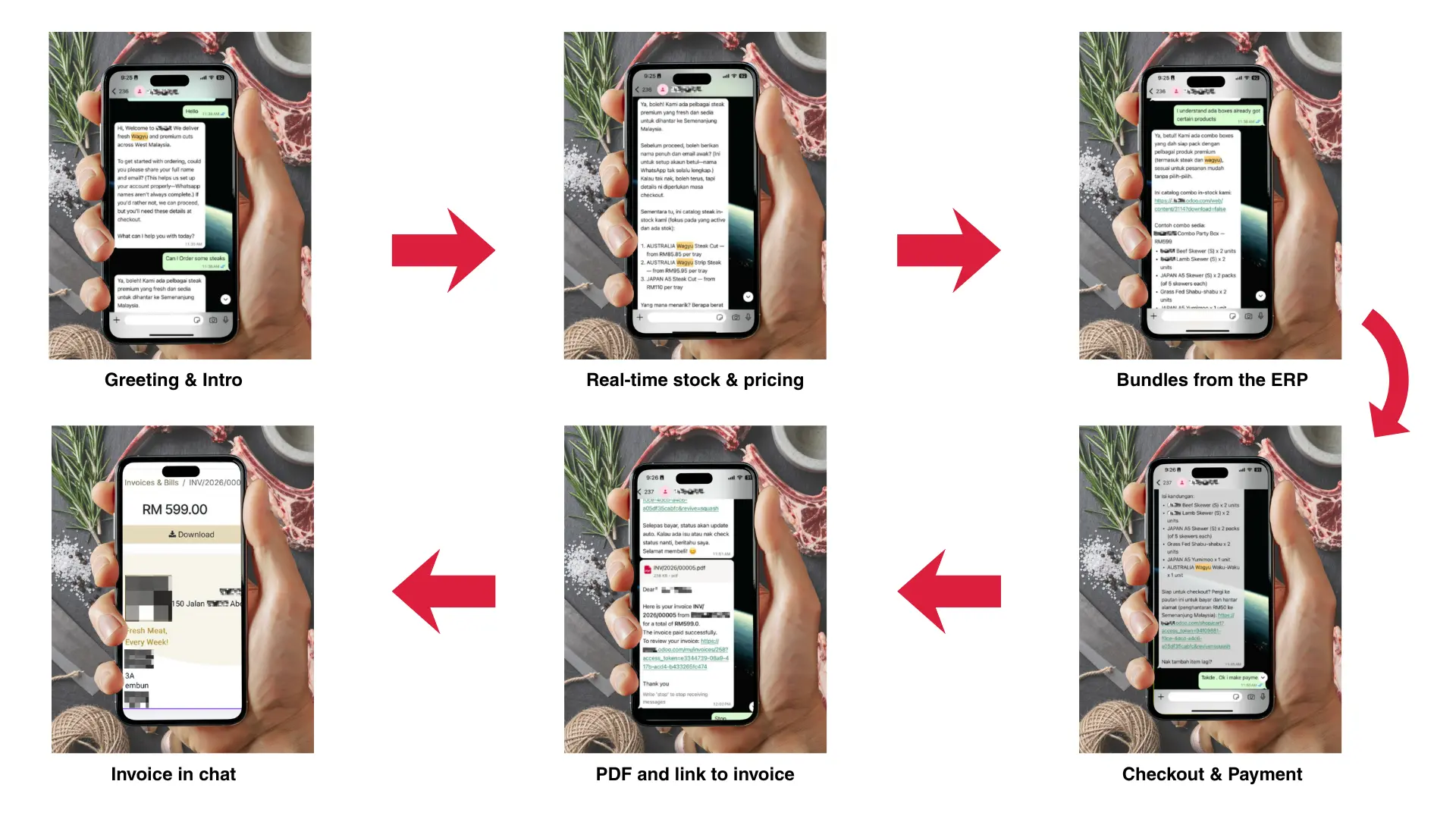
The agent guides a customer from first message to receipt in a single WhatsApp thread.
- Greeting & Intro — AI agent greeting a customer on WhatsApp, introducing the Wagyu delivery service and asking for their name and email to open an account
- Real-time stock & pricing — AI agent listing in-stock steak cuts with live per-tray prices pulled from Odoo, not a static price list
- Bundles from the ERP — AI agent suggesting a pre-packed combo box with itemised contents and price from the Odoo product catalogue
- Checkout & payment — AI agent confirming the order, stating the delivery fee, and sending a checkout payment link inside the WhatsApp chat
- PDF and link to invoice — Paid invoice delivered as a PDF and a review link directly in the WhatsApp chat after the customer completes payment
- Invoice in chat — Odoo invoice opened in chat showing the total amount and a download button, generated automatically from the order
*The conversation flips fluidly between English and Malay the way real Malaysian buyers actually message. That naturalness is a large part of why the hand-off to a bot doesn't feel like one*
The results
Metric | Outcome |
Implementation time | ~3 weeks (vs a 5-month conventional rollout) |
Cost saving | 80% |
Manpower | Reduced — front-line ordering no longer scales with headcount |
Finance | Automated revenue recognition and payment posting |
Operations | Real-time stock movement and reporting |
Human touchpoints | One — picking and packing |
Why it worked
Three things made this more than a chatbot:
- It reads the source of truth. Because the agent queries the ERP live, it sells what actually exists. That removes the single most common manual-commerce error: overselling stock that's already gone.
- It closes the loop, not just the conversation. Most "AI for WhatsApp" stops at the delivery order — the steps that used to consume three teams.
- It speaks the customer's language, literally. Bilingual, code-switching conversation kept the experience native to how the customer base already communicates.
The takeaway
For a high-velocity, premium-perishable retailer, the bottleneck was never demand — it was the manual relay between sales and finance. By collapsing that relay into a single ERP-connected agent, the business turned its busiest channel into one that scales on software rather than on hires.
